Share this post
Not Just to Survive, But to Thrive
Chinatown leaders press Mayor Johnson on federal cuts at community roundtable.
Civic Engagement & Advocacy
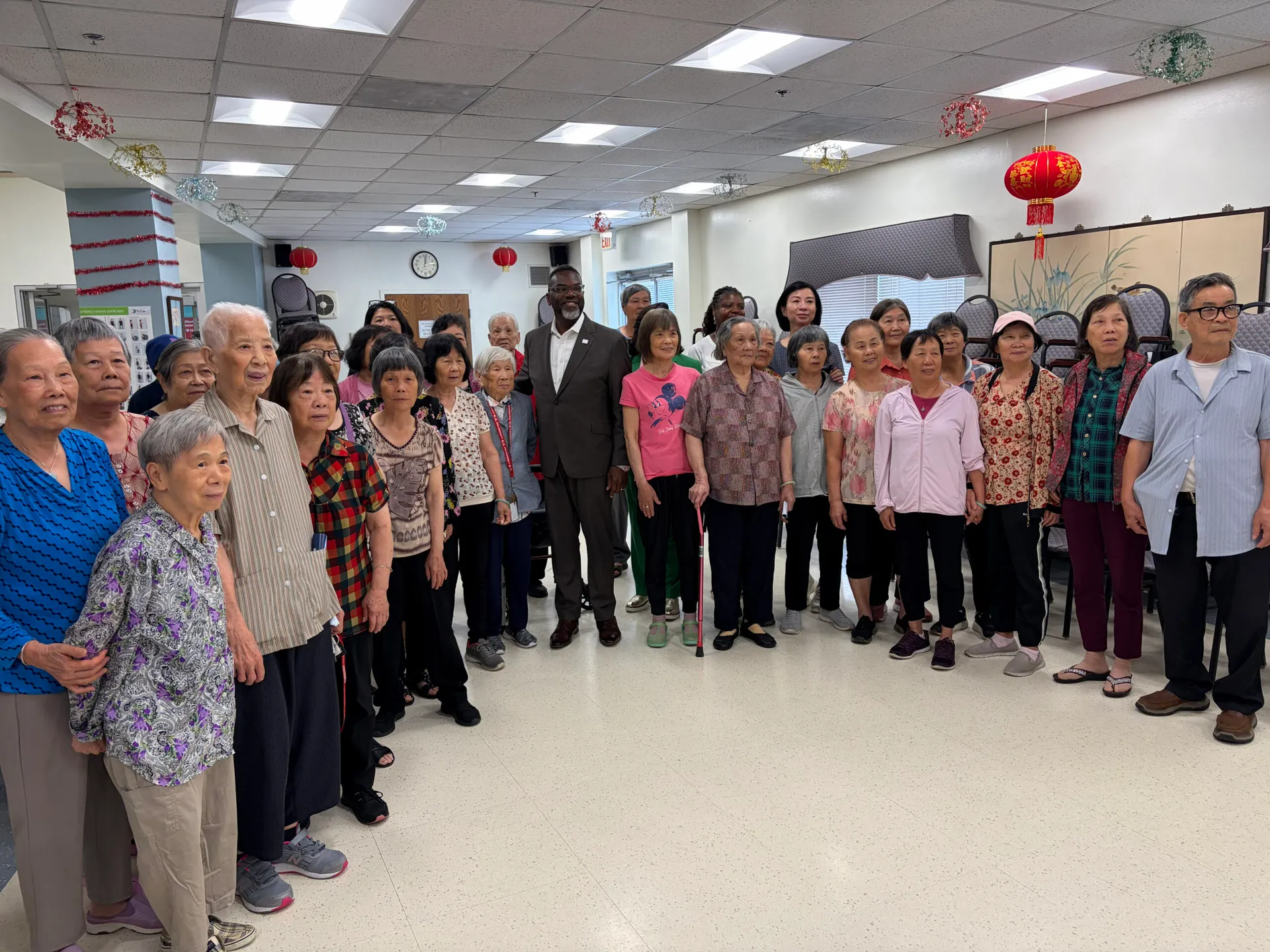
Mayor Brandon Johnson, Ald. Nicole Lee (11th Ward), and city representatives spent the day in Chinatown to hear directly from the people who know the neighborhood best—its residents. The visit began at the Albert and Bernie Wong Senior Living Community, where the mayor sat down with 25 residents to talk about the issues facing seniors and older adults. From there, he came to CASL’s Kam L. Liu building for a roundtable conversation, where community leaders, service providers and city officials spoke candidly about how federal budget cuts are being felt across Chicago’s Chinatown community.
The stakes are high: Chicago’s Chinatown is one of the only Chinatowns in the country that’s still growing, even as similar neighborhoods in other major cities shrink under gentrification and disinvestment. That growth makes continued investment in the community’s infrastructure and services all the more critical.
Connecting with Chinatown Seniors

The morning kicked off with a lively conversation at the Albert and Bernie Wong Senior Living Community. Residents raised concerns about public safety and infrastructure, pointing to the need for safer streets and roads with proper pavement and lighting — particularly around the intersection of Cermak Road and Archer Avenue, the train bridges crossing 23rd and 24th Streets, and the overpasses along Wentworth Avenue. Poor lighting combined with damaged sidewalks, residents said, creates fall hazards that are especially dangerous for older pedestrians.
The older adults also expressed their desire to stay active and engaged in activities around the neighborhood, as well as interest in attending city events. However, they cited the lack of transportation as a barrier for getting around beyond the neighborhood.
In addition to sharing his commitment to address safe streets for seniors, Mayor Johnson had good news about access to city events. Residents can request group transportation through their alderperson, who then submits the request to the Department of Family Support Services (DFSS).
Issues Facing the Community

More than a dozen community leaders, service providers, and city officials packed into Harmony Hall at CASL, ready to speak plainly about what federal cuts are costing their community.
Navigating a Harder Path to Food Assistance: SNAP and Public Benefits Access
Ariel Zhou, Community Program Manager at Pui Tak Center, opened up about how much harder SNAP has become to navigate — especially for older adults heading into retirement. She described residents juggling health limitations and limited English proficiency, on top of confusing notices, tight deadlines, unfamiliar online systems and interviews. Assistance per household has shrunk, she said, and misinformation is spreading through word of mouth in the community.
“This isn’t just about food,” Zhou said. “It’s about dignity.”
Organizations like Pui Tak, CASL and MAHA — all official Illinois Welcoming Centers — are on the front lines of these challenges as they serve the Chinatown community and support new residents. Dr. Hong Liu, executive director of MAHA, spoke to the same need from the ground level: her organization provides Chinese cultural meals along with canned and dry goods to seniors affected by SNAP changes, but currently can only serve the 60616 ZIP code — even though, she said, the need reaches well beyond it.
When School Cuts Reach Beyond the Classroom
The conversation turned next to Chicago Public Schools. Parent mentor Vicky Wu of Project Vision shared her perspective on the toll CPS budget cuts are taking, with layoffs pushing teachers and staff out and leaving families anxious about what’s next. Parents at James Ward Elementary School gathered 300 signatures on a petition citing their concerns and sent it to CPS — and heard nothing back, Wu said, describing a broader breakdown in communication from the district.

Youth representative Jiaying Wu of People Matter connected those cuts to a concern that doesn’t always get attention: teen mental health. Schools do a good job preparing students for college, he said, but that support doesn’t extend to mental health — and the gap widens once kids become adults and head off to school. In the meantime, teens are leaning on friends to fill that void. Wu also pointed out something simple but telling: Chinatown doesn’t have many indoor spaces where teens can just hang out without their parents.
The Cost of Staying for Small Businesses and Residents
The pressures on families extend to the businesses and streets around them. Director of Programs Sarah Tang of CBCAC spoke about the strain on small business and housing in the neighborhood, describing a widening gap between businesses that serve residents and those built for tourists.
“There’s a tipping point where a community stops feeling welcoming — when residents can’t find an affordable place to eat or shop,” Tang said.
Ernie Wong, a community leader and Principal at architecture firm site design group Ltd, added that access to higher education and opportunity — a big part of why people come to Chicago in the first place — is now at risk. Executive Director Caroline Ng of CAMOC raised a related point about the neighborhood’s cultural draw, noting that tourists, researchers and faculty come through the museum, and warning that tourism could decline without continued investment in cultural institutions.
Mayor Johnson's Remarks and City Resources
Mayor Johnson didn’t sugarcoat the scale of the challenge, saying federal cuts are hitting local governments harder than at any point since 1986. That pressure is trickling down to SNAP, school funding, mental health services, small businesses and affordability, he said. His message: the city needs to keep investing in people — education, housing, small business, healthcare. He pointed to the Social Media Amusement and Responsibility Tax (SMART) as one way the city is building sustainable revenue to offset the cuts by feeding into the Protecting Care Fund, which is used specifically for mental and behavioral health operations. However, Mayor Johnson noted Illinois schools remain underfunded, with the state only providing about 25% of funding, compared to a national average of about 47%. This puts more pressure on the local government to cover the funding gap.
Deputy Mayor Beatriz Ponce de Leon (Office of Immigrant, Migrant and Refugee Rights) echoed those concerns, adding that there’s currently no resettlement plan in place and pointing to ongoing attacks on immigrant and refugee communities as an added strain.
Commissioner Angela Green (DFSS) shared that roughly 600,000 Chicagoans are affected by SNAP changes, especially with the work requirement age expanding from 55 to 64. She pointed residents to abe.illinois.gov and Protecting Chicago for the latest SNAP updates, plus volunteer opportunities for seniors through the city and job-readiness support through JobReady Illinois and Serve Illinois. For anyone needing food assistance, she recommended calling 211 or 311. For nonresidents, she urged them to stay connected with the Illinois Coalition for Immigrant and Refugee Rights (ICIRR) for the latest updates on SNAP eligibility and benefits.
The Mayor’s Office closed with a final call to action: show up at City Council meetings, so the mayor and council can hear these concerns firsthand and help shape local solutions — solutions that will determine whether one of the nation’s few growing Chinatowns keeps thriving, or starts to strain under the weight of these cuts.
Ald. Nicole Lee brought the roundtable to a close with a reminder of what brought everyone into the room in the first place:
“One thing everyone in this room has in common is love for this community — a community that is here, a community we want in the future. Not just to survive but to thrive.”