Share this post
Staying Strong, Staying Connected: 5 Tips for Healthy Aging
Everyone deserves to grow older with dignity, independence, and community. Small, steady habits can help protect your health and the health of the older adults you love. Here are five practical, research-backed tips, plus ways CASL can support you along the way.
Health and Wellness
Written by Viana Chau, Grant Writer, CASL
Everyone deserves to grow older with dignity, independence, and community. But falls, loss of mobility, dementia, and isolation can make that harder. The good news is that small, steady habits can help protect your health and the health of the older adults you love. Below are five practical, research-backed tips, plus ways CASL can support you along the way.
1. Make strength training part of your routine.
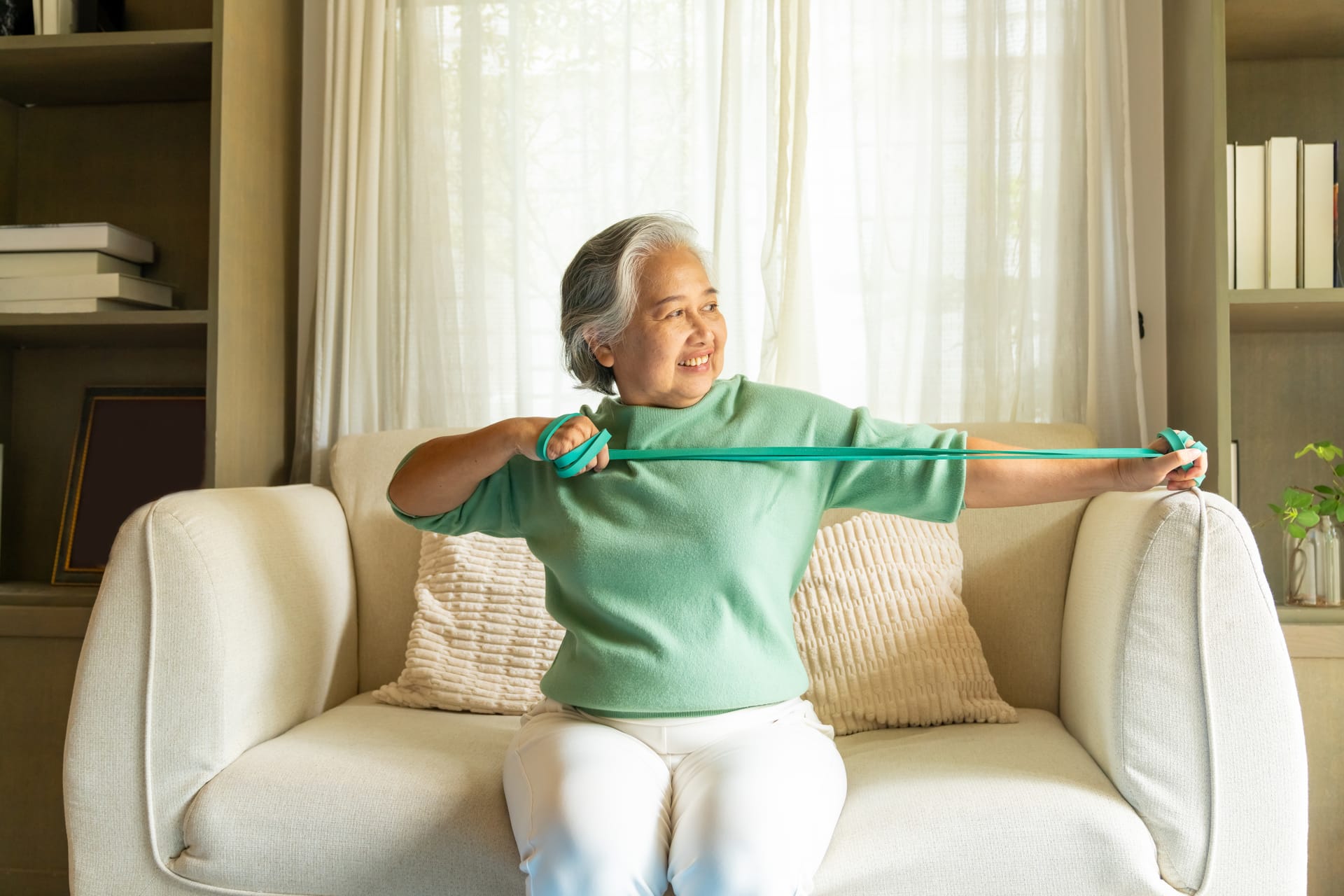
Muscles easily become weak if we don’t use them. Weak muscles make it difficult to get up from a chair, carry groceries, go up and down stairs, and do our daily care routines.
The facts:
- Adults who do not do regular strength training lose about 4-6 pounds of muscle mass per decade. People with moderate to severe muscle loss have a 1.5-4.6 times higher risk of disability. Age-related muscle loss can begin as early as age 35, causing a 1-2% decrease in muscle per year. After age 60, muscle loss accelerates to 3% per year.[1]
- Losing grip strength increases the risk of mortality, including from cardiovascular disease, heart attack, and stroke. Grip strength is an even stronger predictor of all-cause and cardiovascular death than high blood pressure.[2]
- It’s never too late to start being active. A study showed that frail nursing home residents aged 90-96 who engaged in high-resistance weight training were able to significantly improve their muscle strength, size, and functional mobility. [3]
The tips:
- Warm up with gentle movement using Tai Chi or yoga.
- Do simple bodyweight exercises, such as:
- Cool down with gentle stretches using Tai Chi or yoga.
How CASL can help:
- CASL’s Enhance Fitness® classes are built for older adults and help build strength, lift mood, and create connections. Classes are offered multiple times a week.
- CASL’s daily Adult Day Services includes fall prevention exercises as part of the daily routine, so participants stay active in a supportive setting.
- CASL’s monthly Memory Cafés invite older adults with or at risk of dementia to move together through seated chair exercises and rhythm games.
2. Improve your balance and stability.
Balance and stability help us catch ourselves if we stumble or fall—and falls can be debilitating for older adults. Additionally, balance and stability help us walk more efficiently. This improves longevity.
The facts:
- Falls are a leading cause of injury and death among older adults. One study shows that adults aged 51-75 who could stand on one leg for 10 seconds had a lower risk of mortality. [4]
- 3 months after a hip fracture, older adults have a 5-to-8 times increased risk of death. This risk of death continues year after year, with men having an even higher risk than women.[5]
- Muscle loss reduces your balance and stability. Training the muscles involved in balance helps prevent falls and injuries, which preserves your independence.
The tips:
- Warm up with gentle movement using Tai Chi or yoga.
- Do simple balance and stability exercises, such as:
- Cool down with gentle stretches using Tai Chi or yoga.
How CASL can help:
- CASL’s Enhance Fitness® classes also help improve balance and lower fall risk, and you’ll build connections with peers along the way. Classes run multiple times a week.
- CASL’s daily Adult Day Services program includes fall prevention exercises that can help reduce the risk of falls and hospital admission.
- CASL’s In-Home Services program helps keep older adults safe at home. 99.34% of participants do not have any fall incidents.
3. Eat well and sleep well.
A good diet and sleep routine are important all throughout life.
The facts:
- Eating protein (and doing strength training) slows down muscle loss. A person can benefit from eating 1.0-1.3 grams of protein per kilogram of body weight daily. This translates to 68-88 grams of protein (20-30 grams of protein per meal) for a 150-pound person.
- Whole foods and plant-based diets reduce inflammation, which lowers your risk of heart disease, diabetes, cognitive decline, and other chronic diseases.
- Drink enough water throughout the day, even if you don’t feel thirsty. It’s very easy to become dehydrated, especially if your mobility is limited.
- You still need good-quality sleep, even though you may have a harder time falling asleep and staying asleep as you get older. A lack of sleep negatively impacts your memory, emotional regulation, bodily functions, and appearance.[6]
The tips:
- Add more protein to your meals. Examples of healthy sources of protein include:
- 3-4 oz. of chicken breast
- 1 cup of Greek yogurt or cottage cheese
- 1 can of tuna
- 3 eggs
- 5 oz. of tofu
- Reduce your intake of ultra-processed foods to reduce your body’s inflammation. Focus on eating more whole foods and plant-based foods, such as:
- Fruits & vegetables
- Lean protein at each meal
- Whole grains
- Healthy fats (olive oil, nuts, seeds, avocados)
- Foods (or supplements) high in calcium & vitamin D
- If you have sleep problems, consult a doctor. Sleep problems may be due to snoring, medication side effects, or medical conditions.
How CASL can help:
- CASL’s daily Adult Day Services program provides our older adults with dietician-approved, culturally relevant meals and snacks throughout the day.
- CASL’s In-Home Services program involves multilingual Home Care Aides who help older adults with daily tasks such as preparing culturally-relevant meals, going grocery shopping, bathing, dressing, and doing light housekeeping.
4. Find opportunities for social and mental engagement.
Many older adults, especially those who are homebound, are socially isolated. Social isolation leads to both mental health and physical health concerns. Furthermore, a lack of mental stimulation accelerates cognitive decline.
The facts:
- Social isolation can result in loneliness, stress, mental and physical illness, and death. A lack of social connection can increase the risk of dementia by 50%, stroke by 32%, and heart disease by 29%. Some studies show that loneliness increases the risk of mortality by 50%—which is higher than mortality due to air pollution, obesity, or alcohol overuse.[7]
- A cognitively active and stimulating lifestyle in old age may delay the onset of Alzheimer’s disease by up to 5 years. Cognitive activities include reading, writing, playing games, doing arts and crafts, interacting with friends, and reminiscing about the past.[8]
- One in four (25% of) Asian Americans say that they have lack of family support, and 18% of Asian Americans are aware of signs of dementia. This makes it difficult to know when to seek professional help.
The tips:
- Join community groups and activities: Encourage older adults to join community groups of interest, or to reconnect with friends. Participating in fun activities and having meaningful conversations with others can reduce social isolation.
- Cognitive stimulation therapy: Engage older adults in activities and exercises that emphasize thinking, concentration, communication, and memory. This can include playing games, doing arts and crafts, and singing to old songs.
- Learn a new skill or rediscover an old skill: Suggest a new skill that older adults can learn, such as learning a new language or learning how to use technology. Or, help them rediscover a skill they used to enjoy, such as cooking or playing instruments.
How CASL can help:
- CASL’s daily Adult Day Services program allows older adults to connect with peers and build friendships. We provide transportation to and from the program, and also to various shopping trips and outings.
- CASL’s monthly Memory Cafés engage older adults with or at risk of dementia in puzzle activities, simple dancing and rhythm movement, and creating artwork.
- CASL’s Pine Tree Senior Council is a self-driven social and civic engagement group that empowers older adults to be active in the community. Members take field trips, practice calligraphy, sing, dance, and participate in other community events.
5. Regularly seek preventive care and monitoring.
More frequent visits (every 3-6 months) may be necessary to monitor multiple conditions and medications.
The facts and tips:
- The U.S. Preventive Services Task Force recommends several key screenings for people in their 60s and 70s:
- Blood pressure checks to monitor hypertension, which increases risk of heart disease, stroke, and cognitive decline.
- Cholesterol screening to monitor cardiovascular disease.
- Diabetes screening, which is a higher risk as we age.
- Bone density screening to monitor osteoporosis, particular for women over 65.
- Additionally, older adults should regularly have the following:
- Annual primary care visits
- Vision and hearing tests
- Influenza vaccines
- Updated COVID-19 vaccines[9]
How CASL can help:
- CASL’s daily Adult Day Services program has a registered nurse on site, who regularly checks participants’ vitals and other health metrics.
- CASL’s In-Home Services program has a high success rate of keeping older adults safe and healthy at home. 99.01% of participants do not have any ER visits, and 98.85% of participants do not have any hospitalizations. Among those who were hospitalized, 100% of them did not have hospital readmission within 30 days.
Aging well doesn’t take big changes. It takes small, steady habits: moving a little each day, eating well, staying connected, and keeping up with regular checkups. And you don’t have to do it alone. Whether you’re an older adult or caring for one, CASL is here to help, through Enhance Fitness classes, Adult Day Services, Memory Cafés, In-Home Services, and more.
To learn more or find the right program for your family, contact CASL.
Sources
[1] Harvard Health Publishing. “Age and Muscle Loss.” https://www.health.harvard.edu/exercise-and-fitness/age-and-muscle-loss-YAQZ7EMP
[2] Leong DP, et al. “Prognostic value of grip strength: findings from the Prospective Urban Rural Epidemiology (PURE) study.” The Lancet, 2015. https://www.thelancet.com/journals/lancet/article/PIIS0140-6736(14)62000-6/abstract
[3] Stanford Medicine. “Healthy Habits for Successful Aging in Your 60s and 70s.” 2026. https://med.stanford.edu/news/insights/2026/01/healthy-habits-for-successful-aging-60s-and-70s.html
[4] UCLA Health. “Why Balance Is So Important and How to Improve It.” https://www.uclahealth.org/news/article/why-balance-so-important-and-how-improve-it
[5] Haentjens P, et al. “Meta-analysis: Excess mortality after hip fracture among older women and men.” Annals of Internal Medicine 152(6):380–390, 2010. https://pubmed.ncbi.nlm.nih.gov/20231569/
[6] Johns Hopkins Medicine. “It’s Never Too Late: Five Healthy Steps at Any Age.” https://www.hopkinsmedicine.org/health/wellness-and-prevention/its-never-too-late-five-healthy-steps-at-any-age
[7] National Council on Aging. “Navigating Social Isolation and Loneliness as an Older Adult.” https://www.ncoa.org/article/navigating-social-isolation-and-loneliness-as-an-older-adult/; Wu B. “Social isolation and loneliness among older adults in the context of COVID-19: a global challenge.” Global Health Research and Policy 5, 27, 2020. https://link.springer.com/article/10.1186/s41256-020-00154-3
[8] American Academy of Neurology. “Think About This: Keeping Your Brain Active May Delay Alzheimer’s Dementia 5 Years.” Press release, July 14, 2021. https://www.aan.com/PressRoom/Home/PressRelease/4909
[9] Stanford Medicine. “Healthy Habits for Successful Aging in Your 60s and 70s.” 2026. https://med.stanford.edu/news/insights/2026/01/healthy-habits-for-successful-aging-60s-and-70s.html