Share this post
Registered, Protected, Counted: Allies United Gathers Ahead of Election Day
On the morning of October 13, more than 70 community leaders filled Instituto del Progreso Latino for the Allied United coalition’s fourth breakfast.
Civic Engagement & Advocacy
On the morning of October 13, more than 70 community leaders filled Instituto del Progreso Latino for the Allied United coalition’s fourth breakfast, three weeks before Election Day. Karina Ayala-Bermejo, President & CEO of Instituto, offered the welcome and land acknowledgement. Annie Reyes, Vice President of Marketing & Communications at CASL, then led a grounding activity, inviting speakers to paint a picture of themselves by describing their hair, clothing, glasses and jewelry, so the room was inclusive of everyone regardless of sightlines. It was a small act, and it set the tone for a morning built on being seen.

It Started with a Refusal
Karen Freeman-Wilson, President & CEO of the Chicago Urban League, told the story of how the coalition in the room came to exist. In 2020, Black and Latino nonprofit leaders in Chicago decided they would not face the aftermath of George Floyd’s murder alone. With support from IDHS and the Chicago Community Trust, they built Two-Thirds United. Then, in 2025, federal threats escalated. Immigration enforcement intensified across Chicago, and organizations that had long worked side by side, but mostly separately, found themselves facing the same challenges. The Illinois Latino Agenda joined, and Asian American, Arab American, Muslim, LGBTQ+, disability rights and immigrant organizations followed. Allies United, an intersectional, multiracial, multi-faith coalition, was born.
What keeps it working, Freeman-Wilson said, is that the partners take turns. No single organization owns the table. Hosting rotates, from Casa Central’s first breakfast to CASL’s second and Urban League’s third to this week’s at Instituto, so every member knows what it is to lead and what it is to show up for someone else’s community. “If you want to go fast, go alone,” she said. “If you want to go far, go together.”
Seeing Ourselves in Each Other’s Stories

If the coalition’s origin is a refusal, its Solidarity Statement is the answer to a harder question. Mariana Osoria, CEO of Gads Hill Center, and Adam Slade, Director, State Fiscal Policy & Governance at the Illinois Black Advocacy Initiative, introduced a solidarity statement the partners workshopped together. They invited coalition members in the room to do the same.
They framed it with two questions: what brought us together, and how are we mixing ourselves into each of these stories so that when one of us is attacked, we see ourselves in each other?
The statement names the histories of Black, Latino, Asian American, Muslim and Arab American communities, of the workers whose labor built Illinois, and of the Indigenous nations of this land. It commits the coalition to listening, to supporting policies that address those harms, and to holding itself accountable rather than treating the statement as a formality. It closes with Dr. Martin Luther King Jr.’s words: “Any injustice anywhere is an injustice everywhere.”
From Solidarity to the Ballot

With the question of why they stand together answered, the morning turned to what standing together looks like in practice. Amina Barhumi, executive director of the Muslim Civic Coalition, moderated a panel called “Vote! Your Life Depends on It.”
Registration is the gap. Dra. Leonor Vanik, CEO of the National Coalition for Latinxs with Disabilities (CNLD) and one of its 27 cofounders, presented the Daisy-Cosmos Vote Chain. About 40.2 million eligible U.S. voters had disabilities in 2024. Voters with cognitive disabilities, the fastest-growing group, reported turnout of 51.6%. CNLD’s own analysis finds that 78% of the turnout gap among Latino citizens with disabilities opens at registration. Her ask for the room: pledge one action (register, verify your registration, vote, or support another voter), then invite four people to do the same. She pointed to a randomized pilot study in which a friend, relative or neighbor asking raised turnout by 13.2 percentage points.
Meet people where they trust you. Dulce Ortiz, executive director of Mano a Mano Family Resource Center and a Waukegan Township Trustee, described how her organization made civic engagement part of its culture. Mano a Mano is certified by the Illinois State Board of Elections as a civic organization, has 15 trained registrars, and asks about voter registration in every community member screening. Its approach: don’t expect people to come to you to register. Bring registration to the places they already trust. Mano a Mano also anchors the Lake County Rapid Response Team for election protection.
Democracy doesn’t defend itself. Christian Harris, state director of Common Cause Illinois, laid out five tools for protecting it: litigation, election protection, legislation, civic education and organizing. Common Cause Illinois reports its litigation protected the sensitive voter information of roughly 8.9 million Illinois voters, and it is building a permanent, statewide Election Protection Coalition.
Our Community Has the Numbers
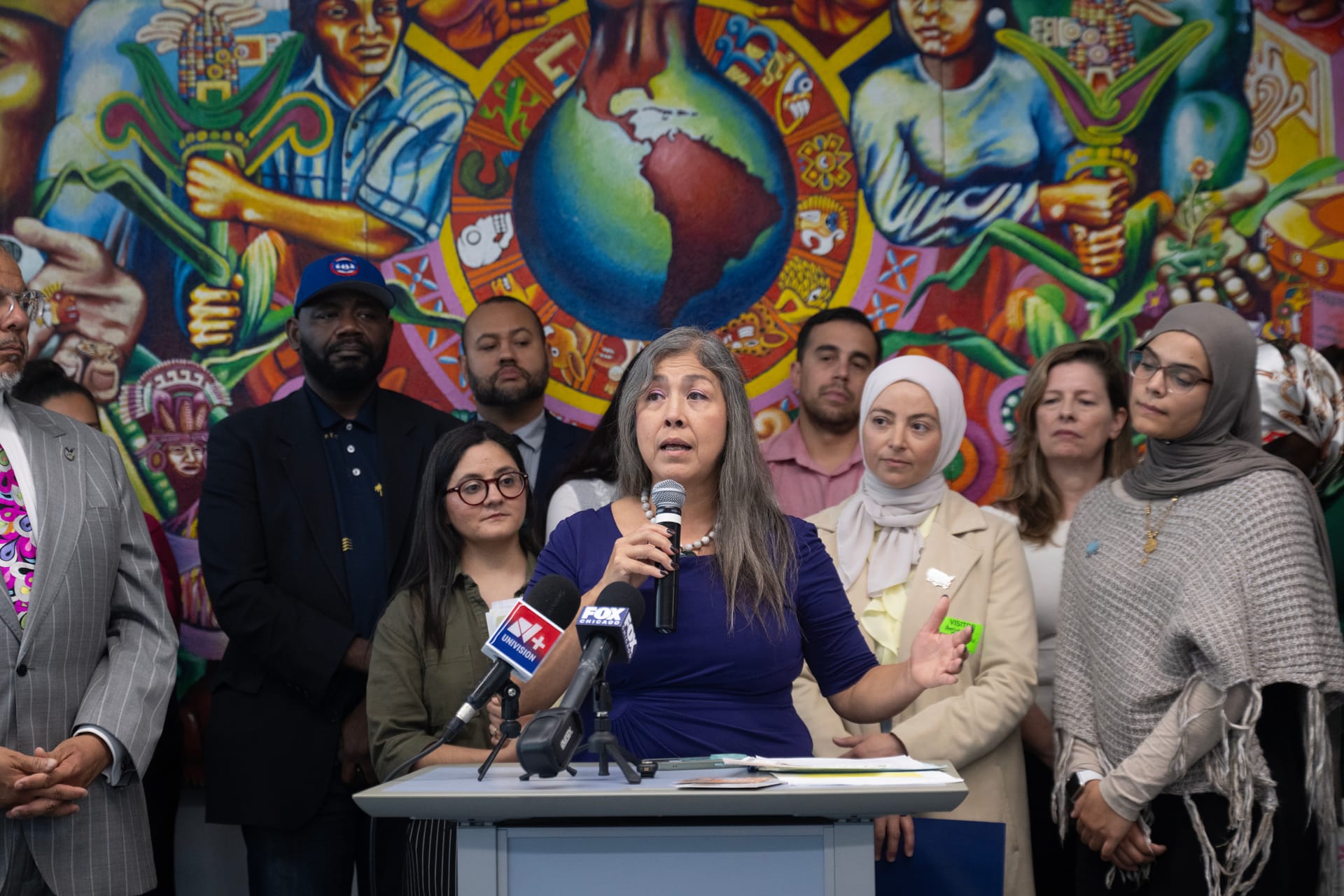
Marty Castro, president & CEO of Casa Central, offered closing remarks, and the morning ended with a press conference, where the coalition’s message went public.
Speaking for the AAPI community within Allies United, Reyes shared two numbers. There are 16 million eligible AAPI voters in the country, and 1.6 million of them became eligible since 2022, making AAPI voters the fastest-growing group of voters in America, growing nearly four times faster than the electorate as a whole. And between 2014 and 2018, Asian American turnout nearly doubled, from 27 percent to 40 percent, faster growth than any other group.
“That tells you something simple: when our community is reached, informed, and invited to the table, we show up,” Reyes said. But growth in numbers protects no one unless people vote. Her ask for the week ahead: check that you’re registered, make a plan for getting to your polling place, and know your rights once you’re there. Anyone who needs help in a language other than English can call 1-888-API-VOTE.
“Our community has the numbers,” she said. “Now we need the votes to match.”
Dates and Resources
Online voter registration closes Sunday, October 18. Illinois also offers same-day registration.
- Early voting runs October 19 to November 2.
- Mail ballot requests are due by 5 p.m. on October 29.
- Election Day is November 3, with polls open 6 a.m. to 7 p.m.
Election Protection Hotline: 866-OUR-VOTE
ICIRR Family Support Hotline: 855-435-7693
Four breakfasts in, Allies United is still doing what it set out to do: showing up for each other’s communities, not just its own. CASL is proud to be part of this coalition, and the work continues through Election Day and beyond.