Share this post
Who Gets Left Out When Data Does the Talking?
A day of honest answers at the 2026 ChangeInSight Data Equity Summit
Civic Engagement & Advocacy
Over 60 nonprofit leaders, funders, researchers, and public officials filled the fourth floor of Impact House in Chicago on October 16, 2026, for the ChangeInSight Data Equity Summit. ChangeInSight is powered by CASL, and this year’s summit was made possible by main sponsor the Julian Grace Foundation.
We came together to ask a practical question: As artificial intelligence (AI) changes how organizations collect and use information, what does responsible use look like for the communities behind the numbers? The answer kept coming back to one word: trust.

Starting with Visibility
CASL Chief Executive Officer Paul Luu opened by thanking the funders and partners who have sustained ChangeInSight since the beginning. Then he explained why this work matters.
For decades, he said, dozens of Asian American and Pacific Islander (AAPI) communities have been grouped into a single category in major datasets. The cost is real:
- AAPI-serving nonprofits receive just 34 cents of every $100 in charitable foundation funding, according to Asian Americans and Pacific Islanders in Philanthropy.
- Federal datasets include 20 to 25 Asian ethnic categories. ChangeInSight lets respondents identify across more than 50.
ChangeInSight began in 2022 as a pilot with six organizations in Chicago. Today it includes more than 90 partner organizations and has collected more than 20,000 community surveys.
Breaking data into specific communities, known as disaggregation, shows what a single number hides. Across pooled data, 14.6 percent of respondents reported transportation barriers to services. The rate ranged from 11.2 percent for Filipino respondents to nearly 33 percent for Vietnamese respondents.
Alderwoman Nicole Lee of the 11th Ward helped carry that data to City Council. “Invisibility in the data becomes invisibility in policy,” she said.

She pointed to the Data Disaggregation Ordinance as evidence of progress. Passed May 20, 2026, it requires the Chicago Department of Public Health and the Department of Family and Support Services to collect and publicly release disaggregated data each year across more than 15 ethnic groups.
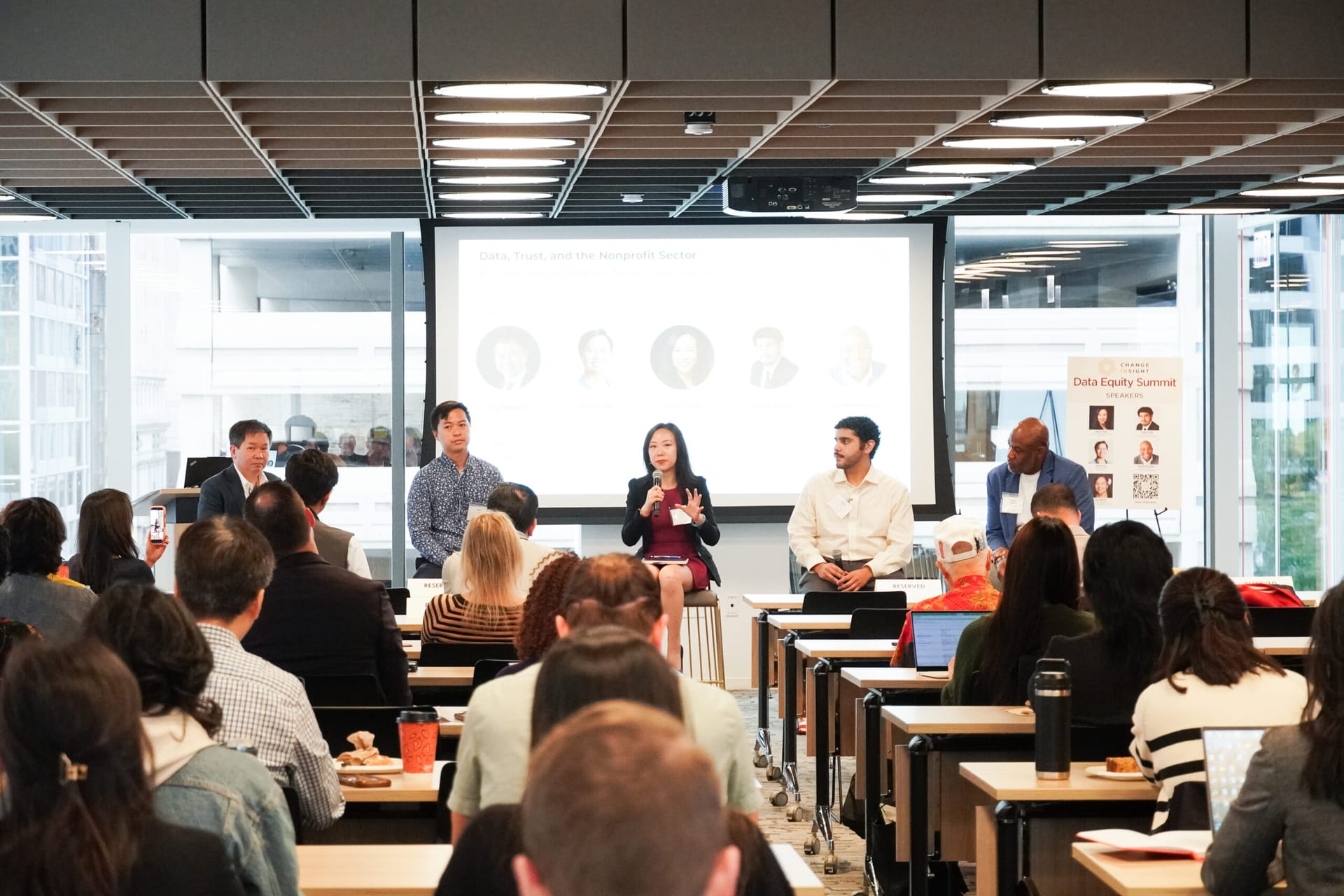
Data, Trust, and the Nonprofit Sector
The morning panel, “Data, Trust, and the Nonprofit Sector,” explored how AI is changing programs, funding, and community trust, and what organizations should do about it. Thy Nguyen, CASL’s vice president of impact and advocacy, moderated.

Panelists were:
- Gina Chen, founder and managing attorney of One Ally
- Julian Diaz, impact associate at the Julian Grace Foundation
- Scott McLellan, executive director of the Julian Grace Foundation
- Theo Lim, head of finance at Synopsis
Chen’s advice was short: “Don’t confuse efficiency with judgment.” She shared an example from survey work.
When responses come in lower than hoped, she said, AI might conclude people aren’t interested in a service. “But as someone who’s worked in the community who know these issues, you know there are other reasons why: ‘Maybe the community does not trust the organization collecting the data.’”
Diaz urged attendees to question where information comes from.
“How are you getting the data? What are the sources? Does it take into account lived experience?” he asked.
McLellan made the stakes concrete. “If we used AI to administer grants, over 50 percent of our current grantees would not get funded,” he said. “That is why human input and lived experience makes a difference.”
He was careful to add that he isn’t anti-AI. “I’m not saying ‘don’t use AI,’” he said. “I’m saying it’s our responsibility to ensure how the technology is used.”
Lim offered a caution for anyone using a large language model (LLM), such as a chatbot. “Always assume that LLMs are using your information to train their models,” he said. “That’s why it’s so important to safeguard the information you submit when using one.”
The conversation wasn’t a warning to stay away. AI can take on administrative and research-heavy tasks, freeing people for the contextual interpretation technology can’t do. It’s a capacity builder, not a replacement for human discernment.
Nguyen closed the session by connecting it to the mission. “We are building capacity for transforming communities,” he said
What We Ask Shapes What We Learn
After a break, Liza Merrill, interim executive director of Asian Pacific Community in Action, led a ChangeInSight partner session. Her topic: how cultural humility, disaggregation, and trust lead to better community data. David Li, CASL’s community data strategist, facilitated.

Merrill described a scene many in the room knew well: arriving in a community with “pens and surveys ready,” only to find people didn’t want to take part, or that answers began with “What do you want me to say?” Her advice: “When we work with community, it is best to be invited or get to know a trusted member of community.”
She drew a clear line between knowing and doing. “Cultural competency is the theory. Cultural humility is the practice.”
Humility, she said, prevents stereotyping. “Approaching data collection with openness and respect means acknowledging what we simply don’t know. It means resisting the urge to fit people into pre-existing categories that were never built for them.”
How a question is asked matters as much as the data it produces. “The questions we ask shape the answers we receive,” Merrill said. “Poorly framed questions flatten complexity, reinforce assumptions, and leave communities unseen in their own data.”
Built in Chicago

After lunch, the day came home to Chicago. In “Built in Chicago: Lessons on Trust, Community Data, and What Works in Practice,” longtime ChangeInSight partners shared what it takes to gather information people are willing to give. Li moderated.
Shobhana Johri Verma, executive director of the South Asian American Policy and Research Institute, said her organization has often done this work without funding. “We do this work because we feel it’s important to us,” she said. “We have conducted a lot of this [research] unfunded because we could not find anyone willing to support us in the way that we needed it.”
“Part of what complicates this is the fact that people aren’t educated about why this work is important, and so the cycle continues,” Verma said.
Yihyun Kim, deputy executive director of Hanul Family Alliance, pointed to staff as the place where trust becomes data quality. “Where trust shows up in data quality is evidence that staff have the skills and the tools needed to collect [sensitive] data,” Kim said. “If we are telling our staff to collect this, training and development of staff is really important to the quality of information collected.”
Verma widened the lens. “Data equity is language justice, immigrant rights, economic mobility,” she said. “The work doesn’t stop when we do.”
Nguyen offered the day’s closing thought.
“We need to look at the why,” he said. “Why do people show up when we ask the questions? It’s trust, and that’s built on lived experience.”
What's Next
ChangeInSight is a national collaboration powered by CASL. There are three ways to join in:
- Community-based organizations can join the partner network.
- Funders can help expand the work.
- Public officials can be our allies in making the case for disaggregation.
To learn more, visit changeinsight.org or contact Rachel Hirsh, CASL’s director of data equity and impact, at rachel.hirsh@casl.org.
Thank you to everyone who joined us, and to the speakers, partners, volunteers, and staff who made the day possible. We are especially grateful to the Julian Grace Foundation, the main sponsor of this year’s summit, and to in-kind sponsor Fly By Jing, which provided sauces for the day.